Skip to content
Back to recipe collection

Cypriot Cuisine Desserts

Cypriot Green Walnut Preserve (Kıbrıs Ceviz Macunu)

Green walnuts are soaked in water for a week, firmed with food-grade slaked lime and cooked whole in a syrup with cloves and lemon.

Prep 1 h 30 minCook 1 h 30 minTotal 204 hServings 50Difficulty Hard

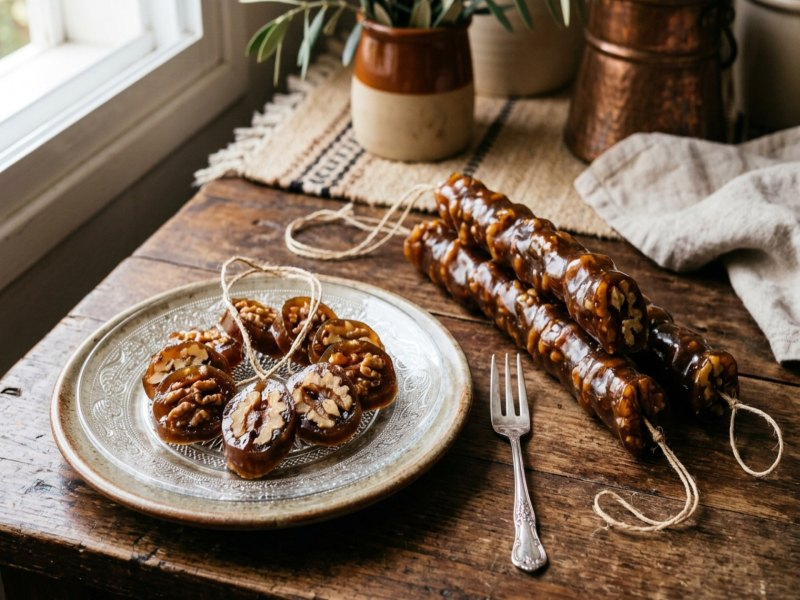
Representative photo — illustrative example

Vote saved, thank you!

Last editorial review: 12.10.2026
Share:
Embed Code (HTML)

Copy and paste this snippet into your blog or website:

Step by step

Preparation steps

Check off the steps you've completed; your progress is saved on this device.

Choose and peel the walnuts

Use green walnuts picked between late May and mid June, before the inner shell has formed; a toothpick pushed in at one end should pass right through the walnut from end to end without resistance. Wearing gloves, thinly peel off the green outer skin of the walnuts with a vegetable peeler, then cut off and discard the hard tip where the stem was attached.

Chef's tip: Walnut juice stains hands and worktops a dark brown that will not come off for several days; wear gloves and use a plastic chopping board.

Pierce and drop into water

Pierce each walnut once lengthwise and once crosswise with a skewer. Without delay, put the pierced walnuts into a large basin filled with cold water.

Leave in water for a week

Keep the walnuts in a cool place for 7 days, changing the water twice a day, morning and evening. It is normal for the walnuts to darken and the water to turn dark; this soaking removes the walnuts' bitterness.

Firm up in limewater

At the end of the seventh day, pour off the water. Measure enough fresh water to cover the walnuts; for each litre of water, put 1 heaped tablespoon (15 ml spoon) of food-grade slaked lime (calcium hydroxide) into a piece of muslin, tie it tightly and drop it into the water. Leave the walnuts in this limewater for 8-10 hours, stirring now and then; the lime firms the outer surface of the walnuts and stops them falling apart in the syrup.

Chef's tip: Use only slaked lime (calcium hydroxide) whose packaging states that it is food grade. Do not use quicklime (calcium oxide, also sold as lump or rock lime), and do not use hardware-shop or builders' lime; quicklime heats up and spatters when it comes into contact with water, and it burns. Wear gloves and keep the lime away from your eyes.

Rinse off the lime

Throw away the limewater and the muslin. Wash the walnuts in plenty of cold water, rubbing them with your hands, then leave them in clean cold water for 1 hour. Pour off the water and repeat the washing and the 1-hour soak twice more; no white residue or slippery feel should remain on the surface of the walnuts.

Boil three times

Bring the walnuts to the boil in a pan with plenty of water, boil for 5 minutes, drain and transfer to cold water; repeat this boiling once more. The third time, boil them in fresh water for about 45 minutes, until a skewer slides in and out of a walnut without resistance.

Soak in lemon water

Drain the boiled walnuts, put them in cold water, add half of the lemon juice and leave them for 2 hours. When the time is up, drain the walnuts.

Insert cloves and almonds

Push a clove into the skewer hole of each walnut. If you like, widen the hole a little with the skewer and insert a toasted almond into each walnut as well.

Cover with sugar overnight

Arrange the walnuts in a wide pan, sprinkle the sugar over them and cover the pan with a clean cloth. Leave overnight; the sugar draws the juices out of the walnuts and begins to dissolve.

Cook in syrup until thick

The next day, add the water and the cinnamon stick and set the pan, uncovered, over low heat; once the sugar has completely dissolved, boil for 5 minutes, then take off the heat and leave to rest for 5-6 hours. Repeat this boiling and resting once more. At the final boil, add the remaining lemon juice and take the pan off the heat when the syrup has thickened and coats the back of a spoon (105 °C on a thermometer). Fill boiled glass jars with the cooled walnuts and their syrup and store them in a cool, dark cupboard.

Chef's tip: Do not put the lid on while the syrup is boiling; letting the steam escape is what makes the syrup thicken.

Time's up! Enjoy your meal.

Transparent source info

Source & freshness

Editorial and media review in progress

Last check: 12.10.2026

Recorded editorial source

Your next recipe

Similar recipes

View all →

Culinary & Culture Guides

Related Culinary Guides & Expert Notes

Explore All Guides
Kitchen Guide

Traditional Cypriot Kebab: How to Cook It at Home at 150C

Cypriot kebab is bone-in lamb or kid goat cooked low and slow. Three and a half hours at 150C in a covered pot at home: which cuts to buy, the plain marinade, and what the last twenty minutes are for.

Read more →